Building Dynamic Web Applications: Selecting the Right State Management for Scalability
As frontend web applications grow from simple proofs-of-concept into full-scale enterprise software platforms, handling data consistency across isolated components becomes a major bottleneck. Selecting an incorrect state management paradigm early in your architectural cycle can lead to code complexity, bloated client bundle sizes, and performance regressions.
To build an architecture that scales cleanly without adding unnecessary friction, developers must carefully evaluate their application’s specific requirements against modern state paradigms.
1. The Breakdown of Current State Paradigms
Modern frontend ecosystems segment state into three primary tiers. Let's analyze how each operates:
[Application State Landscape]
 ├── Global Store (Zustand, Redux Toolkit) -> For cross-domain, heavy data architectures
 ├── Server/Cache State (TanStack Query)     -> For automated data synchronization & tracking
 └── Local/Prop State (React Context, Hooks) -> For micro-level, layout-isolated variables
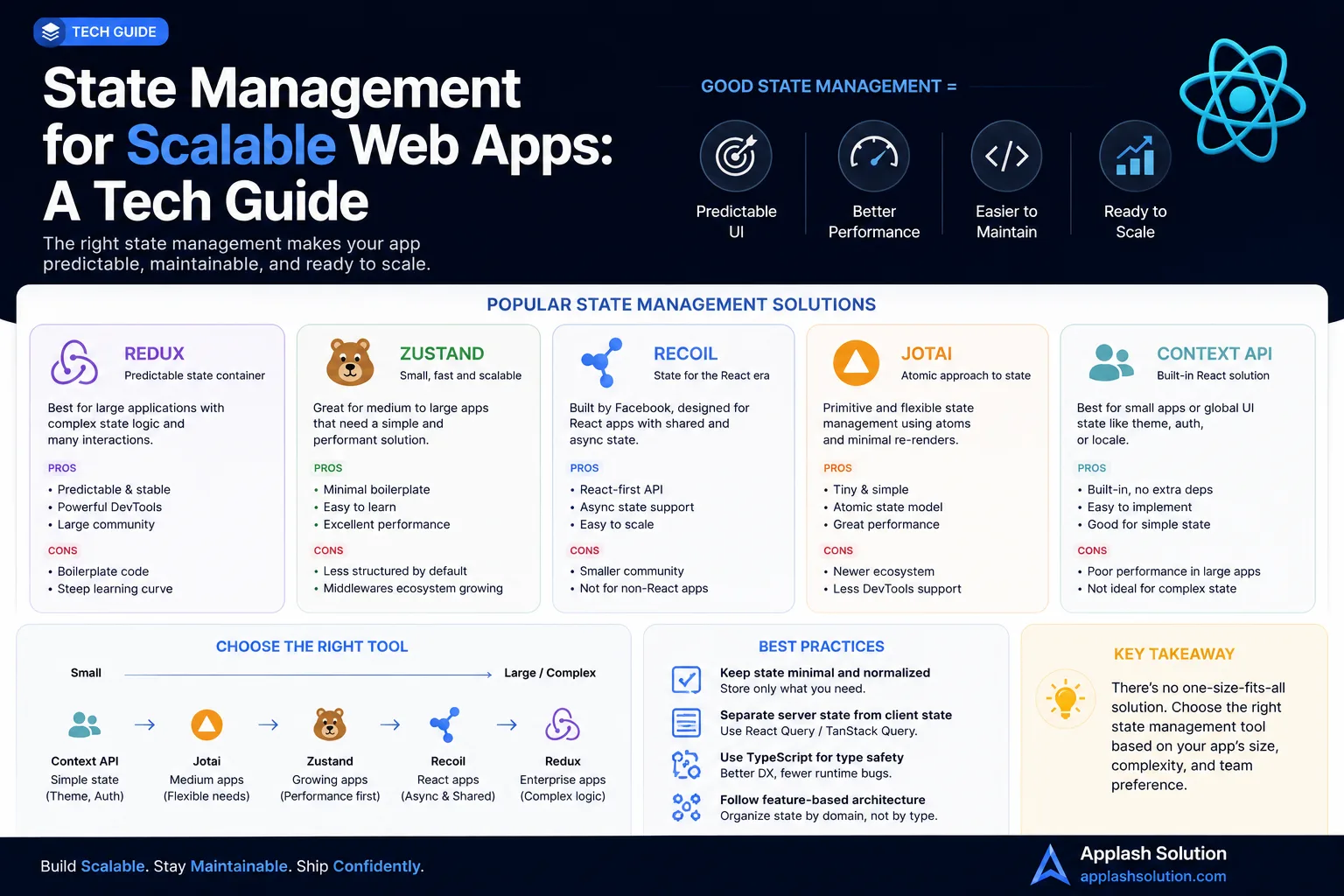
Tier A: Native Context API (Perfect for Small-Scale Scopes)
React’s native Context API passes global values down your component tree without forcing manually drilled props.
The Reality: Context is not a dedicated state management system; it is a transport mechanism.
The Scalability Bottleneck: Every time a value inside a Context Provider shifts, every consumer child component under that provider re-renders simultaneously. It is exceptional for near-static global data (like UI theme toggles or user language preferences) but poorly suited for fast-mutating application fields.
Tier B: Atomic & Atomic-Style Stores (Zustand, Recoil)
Zustand has emerged as an industry leader for high-performance React architectures. It uses a clean, hooks-based approach to slice away complex boilerplate logic.
Why It Scales: Components subscribe selectively to specific data slices. If
state.userEmailupdates, a component monitoringstate.sidebarOpenremains untouched. This decouples component rendering and keeps application speeds exceptionally fast.
Tier C: Enterprise Redux (Redux Toolkit)
The traditional heavyweight choice. Redux enforces strict data mutations through a unidirectional flow of explicit Actions, Reducers, and centralized Middleware.
Why It Scales: It provides full architectural predictability and outstanding developer debugging extensions (time-travel debugging).
The Trade-off: The sheer volume of file boilerplate can slow development down. Redux is best reserved for vast, distributed enterprise engineering teams managing massive data pipelines.
2. Decision Matrix: Selecting Your System
Use this framework to match your current production requirements to the right state tool:
| Core Application Feature Set | Recommended Architecture Stack | Primary Technical Benefit |
| Simple Dashboard / Multi-tenant SaaS | Zustand + TanStack Query | Minimum bundle overhead; isolated component rendering loops. |
| Complex FinTech Suite / Data Sync | Redux Toolkit (RTK) | Rigid predictability; advanced ledger state logging. |
| Content-Focused Content Site | React Context API + Local State | Zero external dependencies; fast initial server rendering. |
💡 The Architectural Best Practice: Split Server State from Client State
The single biggest mistake engineering teams make when scaling apps is pulling remote API payloads into global client stores like Redux or Zustand.
Do not store raw API responses in your global client memory. Instead, use a dedicated server cache framework like TanStack Query (React Query) or Next.js native fetch caching to handle server caching, automated re-fetching, data mutation, and loading states.
Reserve your global client tools (like Zustand) exclusively for local, interactive UI states - such as tracking open menus, canvas view configurations, user notification toggles, and multi-step form progress. Adhering to this boundary keeps your application architecture simple, modular, and highly performant.
Work with Applash
Have a process you want to automate?
Tell us how your business works today. A senior person reads every message and replies within one business day.